









Art in small spaces
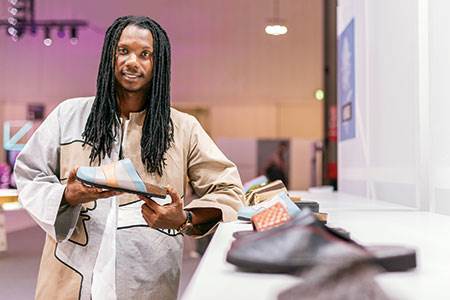
After studying medicine for years, Chukwuma Ekwerike concluded that there is great beauty in the human form. He now uses his design talent to express his love for the patterns he first saw in his anatomy textbooks.
Artist Chukwuma Ekwerike developed such a deep love of the human form that he founded his own fashion concept, Wuman, in 2013 while he was still at university. For him, this was always about “translating my imagination into material reality”; he says turning Wuman into a brand was never his intention. “It was about imagery and expression; I was just drawing and writing,” he insists. Now it is a brand, however, and was one of the 12 that made up the Emerging Designers section at the one-hundredth edition of Micam in Milan in autumn 2025.
Its founder spent four years studying medicine at university in Port Harcourt in his home country, Nigeria. As is common for medical students the world over, he had to spend a considerable length of time poring over textbooks, including the famous Netter Atlas of Human Anatomy. Unlike with most of his fellow students, though, the aspect of these books that made the biggest impression on Mr Ekwerike was that the human form is singularly attractive.
Patterns and beauty
“I became fascinated by the patterns and the beauty,” he says. “I loved looking at human anatomy. I was looking at it from an artistic point of view, making drawings of what this beauty suggested to my imagination. Clearly, many of these drawings were very abstract. I realised that what I really wanted to do was translate this into textiles, garments and other fashion products, to bring these ideas to a wider audience and writing it all out so that people could understand what they are seeing.”
He has collected these writings and published them in two books of his own. One has the title ‘Lines, yarns and words of life’. The other is called ‘Ah, freak her’, a play on words based on the author’s home continent.
Design opportunities
When he told his family he wanted to put his medical studies to one side and pursue his passion for design and art, they reached a compromise. To try to reignite his interest in medicine, his family said he could travel to Europe and continue his studies there. This brought him to Milan for the first time.
After arriving in Europe, he found he was still spending most of his study time drawing, even though he continued to pass the exams. A successful attempt to take part in a programme for young designers helped him make his mind up definitively. “I never liked the practical sessions we had as medical students,” he says. “I never liked seeing blood and it made me sad to encounter people who were ill. I think if I had become a doctor I would probably never have been happy and I would have been tortured by the scenarios I was seeing. I told myself that maybe there was another way I could care for people.” He is now doing this by creating shoes and clothes.
Small canvas
In the footwear collection he showed at Micam, leather sandals in various styles featured prominently. These used leather extensively. One pair had strips of cognac-coloured leather plaited to form a basket-weave effect. Another incorporated wavy combinations of cut leather pieces in sky blue, gold and white.
Chukwuma Ekwerike says he has always been interested in shoes, even if garments were the first products he turned his hand to. He explains that, from the point of view of a visual artist, a shoe is a small canvas on which to present your ideas. But he argues that the trained eye will know his shoes and his garments come from the same designer.
Another of the styles on show in Milan demonstrated this clearly. It was a pair of sandals constructed using woven fabric, with tassels hanging down towards the toe to make a striking fringe. The footwear complements trousers he has designed that also have a fringe on the bottoms.
“It is very comfortable, but it has a dynamic effect when you are walking,” he explains, “and it’s the same dynamic with the shoes as with the trousers. With shoes, you have to find a way of presenting your idea in a small space and, at the same time, find a way of avoiding making it too dramatic, but still making something beautiful and something that includes the essence of the original design. Finding that balance is difficult. That’s why the way you translate a concept into a shoe is different from the way you do with a garment.”
Small the shoes may be, in relative terms, the flowing movement of the fringe on the trousers immediately attracts the eye to the wearer’s feet and this, Mr Ekwerike confirms, is entirely deliberate.
Straightforward way of working
He has worked with a small production team of artisan manufacturers in Nigeria for years. Together, the Wuman team is already supplying a number of stores. The founder is looking forward to more orders coming as a result of the exposure at Micam and insists this will not be anything he and the people he works with cannot handle. “Our way of working is simple,” he explains. “When we receive an order, we lay out our terms and production timelines. Once we receive the first payment, production begins. When the order is ready, we communicate that to the customer. That is how it works for us.”
Micam is far from the only international adventure the brand has had so far. It has customers in diverse parts of the world, including Peru, Italy and the Caribbean, and took the opportunity to run a pop-up boutique at the Galeries Lafayette department store in Paris in the summer of 2025. This followed previous pop-ups in Stockholm, Berlin and Geneva.
Feel more than look
When it comes to sourcing leather, he says is “drawn by the feel more than the look”. Typically he sources it “at home”, from leather producers in the tanning centres of Jos and Kano. Insisting he hasn’t the slightest desire to enter politics, he would like the domestic leather sector in Nigeria to make positive strides. “There is so much potential,” he says, “and I would like to see progress emerge from that.” Looking at the materials in some of the products on display in Milan, he continues, made clear to him how much more Nigeria can do with its people and its natural resources.
“We can’t depend on oil alone,” he concludes, “and we have a vibrant, strong, active population. And there is something extra, something special about Nigeria. You can see it and hear it in Afrobeat music. We can translate this into other sectors, including fashion. We have to act. We have to get this done. It isn’t about simply hoping this will happen, but about becoming the giant Nigeria can be.”
The founder of Nigerian brand Wuman, Chukwuma Ekwerike with the shoes he had on show at Micam in Milan.
Credit: Micam















