








Food for thought
A new digital platform for informing, training and supporting professional development in the circular economy is on the way. Improvements will come through better connections between leather and agri-food.
The leather industry’s main representative body in the European Union (EU), COTANCE, has launched a new project, Symbios. The project will run with the support of the Erasmus+ programme of support for education and training projects. Other project partners include research bodies from Portugal and Spain, a training services provider from Italy and a business organisation from Slovenia. Specialist Milan-based consultancy Spin 360 is also involved.Real opportunities
The aim of Symbios will be to encourage mutually beneficial connections between the leather industry and the agri-food sector. It will seek to identify models of good practice between food producers and leather manufacturers, ideas that can be replicated in different parts of Europe.
Project partners will conduct research on how these models can work across the two sectors. This will include examining the regulatory framework, finding out what current practices are and assessing future potential. COTANCE said at a launch event in Porto in the autumn of 2025 that one of the main outcomes of Symbios will be a new digital platform for informing, training and supporting professional development in the circular economy. This platform will also connect companies and encourage them to work together “through symbiotic practices”.
It will work with Spin360 to lead the leather sector’s involvement in the project. This will involve setting up focus groups to bring together stakeholders from across the leather supply chain. Their work will also involve conducting surveys, interviews and a review of iterature to identify practices that offer “real opportunities for synergies”.
At a critical time
At the event in Porto, COTANCE secretary general, Gustavo González-Quijano said the project was starting at a critical time for the leather industry. He said it had the potential “to turn sustainability into a shared opportunity”, with agri-food and leather moving forward together. He concluded that practical solutions and strong connections would come out of Symbios, helping leather to continue to be “a leader in Europe’s circular economy”.
Behind the project’s name is the compelling idea of “industrial symbiosis”. This describes instances in which one industry tries to make sure material that it will not use is available to a different industry that can use it. COTANCE’s analysis is that industrial symbiosis is “the latest trend in the new industrial paradigm” and one of the main strategies for the transition to a circular economy.
Flow of hides
The most obvious example for the leather industry is cattle hides. These are available in their hundreds of millions from the agri-food sector. Articles we have published in the last 12 or 15 months have laid bare the big benefits that can accrue if the hides flow into the leather value chain instead of going to waste. There are environmental benefits and economic ones.
To sum up, making leather from the hides can result in an environmental impact that is more than 70 times lower than the impact of putting them into landfill. And when it comes to money, to make leather and finished leather products from hides can deliver a total value add of more than 5400%. [That’s not a misprint. ED.]
Projects and communications manager for COTANCE, Vita Kobiela, says Symbios will be important in the context of a wider updating of “bio-products and circular strategies” that she says is taking place in the EU at the moment. A dedicated EU Circular Economy Act is in the works (please see the separate article on page 28). She talks of significant changes to the regulatory and legislative framework around the circular economy and “a new push” towards the transformation away from the old, linear models of making and using things.
A model for symbiosis
Ms Kobiela says specifically that tanners will benefit from the online platform that will emerge from this project. Easy-to-access and easy-to-use online training will be available to help them “develop a model for symbiosis”. She thinks the ties and the mechanisms for sharing information between the agri-food and leather sectors should be stronger and more established than they are at the moment. “Some tanners do have good connections to farmers and meat companies,” she continues. “Certainly in France there are clear examples of this.”
Naturally, this is not a one-way street; there are important opportunities for industrial symbiosis with businesses that can and want to use by-products of the tanning process. In a similar vein, some of the best practice in the arena of encouraging food companies and leather companies to build symbiotic relationships is definitely taking place outside the EU. This need not matter; there are good lessons to learn from what people in other parts of the world are doing.
Among the recent examples from features in World Leather is the relationships that footwear brand Veja has built up with cattle farmers in Brazil, including Victor Wortmann, who runs a ranch called Estância Coxilha, close to the border between Rio Grande do Sul and Uruguay. Accessories brand Coach has products in its collections that it consciously links to regenerative agriculture projects, such as the Heart bag. Professor John Gilliland has conducted detailed analysis of emissions at his cattle farm in Country Derry in Ireland. He has worked out that the soil on his land sequesters more carbon than the farm emits, including emissions from the cattle he raises there. He has gone to net-zero and beyond and he believes others can do the same.
Right to relevance
In the early days, there seemed to be little appetite in the circular economy sector for making leather part of the discussion, in spite of the obviousness of leather’s circularity. It is encouraging now, with the introduction of the Symbios project, to see COTANCE refer to leather as a circular economy leader. “We are trying hard to change the view of leather,” Ms Kobiela says. “This is work that has to continue. The leather industry is relatively small, with less than 1% of the EU’s total gross domestic product, but our strategy with this new push is to show how relevant leather is in this changing economy.”
She talks of previous policies of linking leather to the fashion sector as being in the past now. “There has been a big shift,” she says. “In Brussels, we are now trying to present leather as a good fit for the bioeconomy.” She makes the point that it is up to the leather industry to make this connection clear. Her belief is that the ties to agri-food that come out of the Symbios project can make an important contribution to this.
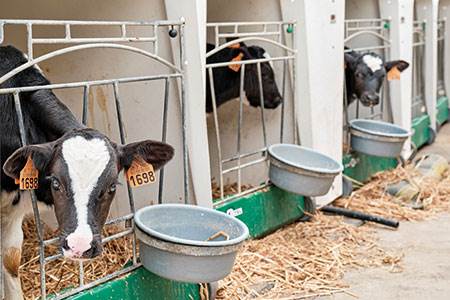
Calves at a farm in Belgium. The Symbios project aims to enable agri-food and leather to move forward together.
Credit: European Commission/Sophie Hugon















