









The fruits of data
Efforts to collect supply chain and production data have begun to yield transparency, traceability and sustainability rewards for companies in the leather industry.
Italian footwear and leathergoods brand Tod’s has won the top prize in the ‘Craft and Artisanship’ category at Italy’s Sustainable Fashion Awards 2025. This is a competition that fashion industry body the Camera Nazionale della Moda Italiana runs. Tod’s won for a project it calls Passport, in which it has worked with partners to create digital passports for customised versions of two of its most iconic products, the Di Bag and the My Gommino shoe.
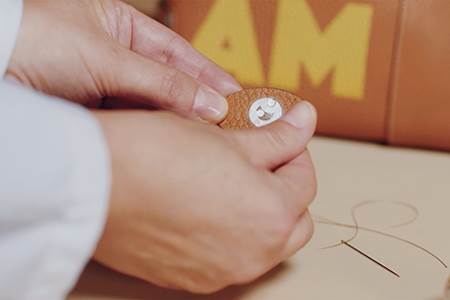
Digital passports allow customers who sign up for personalised purchases to track each step of the creation of the bags or shoes they have bought, from material selection to delivery. For this, Tod’s attaches a near-field communication (NFC) tag from Italian technology provider Temera to the product. An app on the owner’s smartphone will then supply information about the work Tod’s, its artisans and its suppliers have carried out to make the purchase possible.
Blockchain benefits
In addition, this information will also include authenticity, traceability and compliance certification. This means guarantees about quality, sustainability and transparency are available at the click of an icon. A blockchain consortium called Aura, set up by companies in the luxury industry in 2021, is the source of the information. The blockchain technology works by matching information about an individual product to information about its buyer through a chain of secure, non-reproducible, digital blocks.
Tod’s creative director, Matteo Tamburini, said on accepting the Sustainable Fashion Award at a ceremony in Milan at the end of September that Passport celebrates the Florence-based company’s commitment to “merging traditional craftsmanship with sustainable innovation”. He called it the brand’s way of “looking to the future while never forgetting the roots of our tradition”.
Indirect connection
This connection between tradition and the technology-driven future is also a top-of-mind topic at one of Italy’s most famous leather manufacturers, Rino Mastrotto Group. Any connection it has to the Passport project is indirect: Prada, one of the companies, that launched the Aura blockchain project, recently became an investor in Rino Mastrotto Group. Nevertheless, the leather manufacturing group’s manager for environment, social and governance (ESG), Alberto Gallina, is as passionate about collecting data and making full use of it as his counterparts at Tod’s.
For Mr Gallina, the ability to use data to show “in a measurable way” the authenticity and sustainability of materials and finished products is going to be one of the keys to success in the future. He says Rino Mastrotto Group is walking this road itself as a way of differentiating the business. “This takes investment,” he explains.
Rrequests for information
He tells World Leather that he arrived at Rino Mastrotto Group four years ago, after working for more than 20 years in the wider fashion industry and for more than 30 years in sustainability roles. When he started working at the leather manufacturer, he found that the company was already clearly committed to sustainability, but also that there was a need to build a dedicated structure around this commitment. Now, four years on, he works with a team of six people, plus colleagues in different group subsidiaries in Italy and in other parts of the world who are part of the sustainability effort.
It has resulted in what he calls a 360-degree-view of ESG across the group, which is just as well because, in his words, the company is being “inundated with requests for information from brands”. He understands why: 90% of these brands’ environmental impact comes upstream in the supply chain. The leather manufacturer has benefited, too. It has launched what Mr Gallina calls “a new category of leather”.
This is a reference to a product line called Hearth, which the group brought to market earlier this year. It offers the performance and look of previous collections, but with a “significantly reduced” environmental impact. Data-driven improvements it was able to make, particularly at the retanning, dyeing and fatliquoring stages, were what brought this reduction about.
A lifecycle assessment (LCA) exercise it carried out in 2024, compared one square-metre of finished bovine leather made using conventional processes with one produced using the new Hearth method. The results showed that Hearth reduces water use by 91% and chemical input by 23% in these key stages of production. The LCA also identified a 22% reduction in CO2 emissions, decreases of 25% in fossil resource use and in freshwater eutrophication, and a 7% drop in freshwater ecotoxicity.
Grounds for hope
Alberto Gallina accepts that, as a major player in the leather industry, Rino Mastrotto Group was fortunate enough to be in a position to make the necessary investment in time, people and technology to unearth Hearth. His own role is part of that investment. Some help has been on offer from projects that have emerged from the European Union’s Green Deal, but he says these are often hard to access. “Nevertheless, it will be exciting to see what we are able to do with the Hearth method in the future,” he says. “There are grounds for hope that, once the technologies that have brought about the reductions in water, chemicals, energy and emissions are fully developed, they can become available to the whole market.”
He is conscious of the limitations of LCA comparisons, stemming from the fact that companies have their own practices for collecting data and may not measure impact in exactly the same way. “We need to keep investing in LCA, though,” he insists. “We need to keep making progress. I know this from Rino Mastrotto Group’s work on automotive leather in particular. For this, we have talked in detail to car manufacturers and they want to base their sustainability decisions on LCA.”
To share is to care
Fruits of all the investment also include more effective sharing of information within the Group on an everyday basis. This is making it easier to use and reuse information the company has collected to answer questions from different customers. This frees the team up to be more innovative, he says. And as a result, the in-house team is finding time to help customers increase their understanding of how circular the leather manufacturing business is.
“For example, we still talk far too little about durability,” he suggests. “We simplify things by calculating how much water or how much energy it takes to manufacture a product, but we don’t seem to factor in how long the product will last. A product that lasts one year might have an impact of 10, just to put a random number on it. If a competitor product that is made of leather has an impact of, say, 13, it looks on the face of it as though a comparison is bad news for leather. But, of course, the product made from leather could easily last 10 years. We should divide the impact by the entire lifespan of the product. We have to learn to value things that last a long time.”
A tag for a bag.
Tod’s has used electronic tags and blockchain technology to offer buyers of its Di Bag detailed information about the materials and manufacturing processes involved in making
the product.
All credits: Tod’s















