







Complex journey to biocircularity
After decades of looking after Asian manufacturing for big brands, David Solk and Irmi Kreuzer ploughed their resources and experience into creating a shoe in which every element can decompose. Initially focusing on new biobased materials for the upper, their research taught them none could match leather for performance and credentials.
David Solk is frustrated with the footwear industry. Now in his fifth decade in the shoemaking business – starting at his father’s factory in England, through to co-founding an outsource company in Vietnam – he says the big brands have created a model where increasing margins have left the sector “a bit broken”. With a focus on a five or six-times mark-up from the manufacturer, the lead times are too long, there is too much inventory, too much waste and too many markdowns, he says. “A huge barrier to change is that brands don’t make anything themselves. The industry has lost that.”
Feeling disillusioned, David and Irmi Kreuzer wanted to use their experience to show how things could be done better. Their journey together began in 1992 while both were working at adidas, where David led product development teams in Asia and helped establish operations in China and Vietnam. After nearly a decade there, he and Irmi took a leap. In 2003, they founded Shoefabrik, a production company that became a partner for more than 20 brands including Helly Hansen, On Running and Zara, offering services from concept to final production. Inspired by Patagonia’s pioneering approach in the mid-2000s, their team worked with clients to integrate more sustainable materials and processes into footwear manufacturing. But when the financial crisis of 2008 hit, priorities shifted and momentum stalled. Irmi says: “For us, it reached a point where we felt we had two choices: take a leap to help change the industry or consider stepping away from it entirely.”
This leap has landed on biocircularity – a way of approaching the shoe that takes into consideration all aspects from design to end of life. Owning their own facility in Ho Chi Minh, while headquartered in Switzerland, meant they had the ability to work flexibly, with extra research and development and without the usual business constraints, explains David. They financed the project themselves, so they would not need to answer to backers or shareholders. “We wanted to create a beautiful, desirable product but one that would be ultimately harmless. And that was the hardest thing. Everything needs to be compost-capable.”
The aim was to complete the project in two years, but creating almost every element of the shoe from a biodegradable material was more difficult than they had anticipated, even with all their knowledge. Six years later, David describes it as a very long and challenging journey – “and I’m a shoe technician, so I thought I’d be able to get there faster”.
“We actually started out trying to make the shoe without leather,” he tells us. “We explored a range of non-leather alternatives and really pushed to make one of the newer bio-based materials work. But at the time, none of them could meet the performance demands of footwear without relying on plastic. That’s what eventually led us to take a closer look at leather – and to ask whether it could be produced in a way that aligned with our biocircularity goals.”
Nature’s bounty
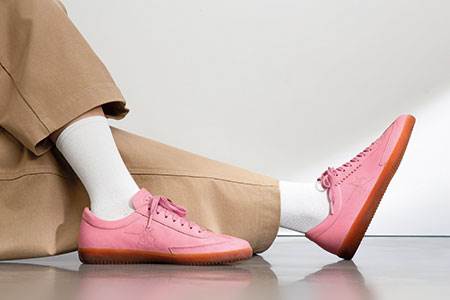
The Solk Fade 101, and the newly launched 201, have been created with a chrome- and metal-free leather upper from a German tannery, developed so it can break down at the end of its life. “This makes it compatible with our takeback system without losing the durability, comfort and longevity that make leather so well suited for footwear. Beyond supporting our biocircularity aims, this leather gives the shoe a premium look and feel, while staying soft, breathable, and naturally comfortable against the foot.”
The outsole is natural rubber and the lining is a custom-developed blend of compostable yarns and plant fibres. The laces and webbings have been made from Lenzing’s Tencel wood pulp, and the glue is partially bio-based.
At the end of the shoes’ life, customers apply for a composting bag on the website, then the shoes will be sent to a company-owned industrial composter in Germany, where they will be ground up and mixed with food waste, grass and other materials and turned into a pre-industrial compost slurry.
All materials have been screened against more than 200 harmful substances by a third-party laboratory and tested for safe plant growth post-composting. “If someone doesn’t return their shoes and they end up in landfill, or even buried by the family dog, we want to be sure they’ll still break down safely and be ultimately harmless as well,” comments David. “We also happen to have our own farm in Germany where we can do all our own experimenting.”
David hopes their model will be one that other footwear brands can learn from, or that partnerships and collaborations can help to spread the message. “You’re fighting a very big machine and mostly customers just don’t know the benefits, yet. It doesn’t need to be a competition all the time, we love to work with other companies.” Given the opportunity to scale, the costs will also come down, he says – and the company doesn’t intend to stop at sneakers. “The leather works hard in use, then breaks down in our controlled system – a small but important example of what circular design can really mean,” he says. “We want to be a catalyst for change and show that if it can be done, maybe it should be done.”
Material composition
- Upper The upper leather is sourced from a German tannery. The leather is chrome free and heavy metal free and has undergone a compost-capable tanning process.
- Laces & webbings These are made of wood pulp from sustainably harvested eucalyptus, beech and spruce trees. This yarn fibre has been certified for biodegradability and compostability in various environments.
- Lace tips Also known as aglets, these tips are made from certified compostable material and are attached by Solk’s own machine so that every lace is the right length and there’s no production waste.
- Glue The partially bio-based glue has been specially tested to fit the requirements for durability and compost capability.
- Lining The one-piece, knitted-to-shape lining is a Solk-developed blend of compostable yarns and plant fibres that are 100% biobased.
- Outsole Pure tree rubber
Debut product, the Fade 101, is available in ivory and sand. The Fade 201 has a larger colour range, adding black, dusty rose, claret, tan, chocolate and navy.
All credits: Solk















