










Unwanted hides will go far
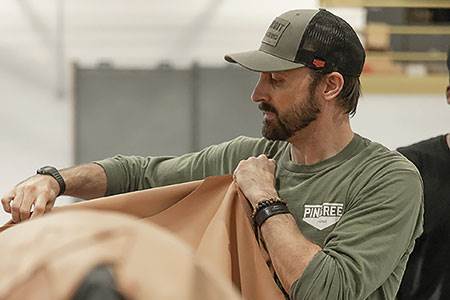
For ten years, worker-owned cooperative Pingree Detroit has been sourcing surplus leather and making it into handmade shoes and accessories.
Automotive leather manufacturer Pangea has donated 600 pieces of leather to a Detroit-based leathergoods producer. Pingree Detroit specialises in using leather reclaimed from the local automotive industry to use in handmade shoes, wallets, card holders, tote bags, coasters, sneakers and other items. A worker-owned cooperative, Pingree Detroit launched ten years ago with the goal of providing employment for armed forces veterans as one of its main aims.
Pangea’s donation consists mostly of finished and semi-finished full-size bovine hides, with some sides too. They were mostly tanned and finished in the company’s facilities in Mexico. Pangea has told World Leather that the material is of good quality but had failed to pass customer approval during the design phase, often because of falling short on a single item on the specification. “That didn’t mean they needed to be scrapped,” the company says. “We held on to them to be able to accumulate this substantial donation.”
The leather manufacturer has called waste reduction a critical component of its environmental strategy. For example, in 2024, its manufacturing site in León in Mexico diverted almost 14 tonnes of leather shavings from going to waste, for use instead in the production of fertiliser. Its donation of 600 pieces of leather to Pingree Detroit is another example. “It gives us great pride to know these hides will be used for other goods, instead of ending up in a landfill,” Pangea adds. Pingree Detroit confirms that Pangea’s donation is the largest it has received so far this year and will provide enough material for its team to produce around 3,500 handmade products.
Worker-owned
The people who will make these 3,500 handmade products start off as employees of Pingree Detroit. No experience is necessary for people to start working there but, after a year at the company, they have the option to take a share in its ownership. This involves taking part in a 10-module leathergoods training course, led by their more experienced colleagues. This takes eight weeks. When they complete the course, their peers vote to approve them as new co-owners of the company.
Co-founder and chief executive, Jarret Schlaff, says this set-up benefits the business. “We teach people every part of the craft,” he explains. “Team members learn how to research and design products, grade and skive leather, prepare it for sewing, make patterns, cut, sew and finish pieces with edge paint and other techniques. We also offer a 12-week shoemaking programme that can extend to 18 weeks for those who want to specialise.” Leadership development training is also part of the teaching. These courses are free and the company pays people for every hour they spend training.
As a result, team members “think like owners” and develop an understanding of all aspects of the operation, he explains. “They have a voice in the big-picture decisions that shape our cooperative’s future,” he says. “Ownership is not just a title. It’s a shared responsibility and a shared reward.” This includes a financial reward; 77% of profits at Pingree Detroit are distributed to the pool of worker-owners.
It celebrates its commitment to forces veterans, but Mr Schlaff makes it clear that anyone can join the workforce. “We just focus on attracting and retaining leaders who have a mission-first attitude and a commitment to service above self,” he explains. “Veterans are some of the best leaders there are; we do our best to surround ourselves with those who live a life of service.” Each product comes with a tag with a picture and quote from the person who made it to let customers know something about the provenance of their purchases.
“We keep the focus on the craftsmanship, creativity and teamwork of the people who make what we do possible, and not on the challenges they have faced,” the co-founder explains. “Everyone comes here with a story, but what unites us is a shared purpose and pride in what we are building together.” There is what he calls “wrap-around support” to help people thrive, which includes transportation assistance. On the factory floor, there are mindful breaks every 90 minutes, and a rotating wellbeing manager helps to make sure everyone is cared for.
He adds: “By meeting people where they are, trusting one another and focusing on growth, we create an environment in which every team member can bring their best self, continuously improve and heal.” He describes the overall aim as making sure everyone who joins the company “has the skills, confidence and support to grow and carry Detroit’s tradition of craftsmanship forward”.
Waste makes no sense
Mr Schlaff’s own background is in sustainability roles, with no direct link to the leather industry or the wider fashion sector. While still an undergraduate, he worked for a time in pollution prevention for the state of Michigan on a project aimed at helping automotive manufacturers there reduce the volume of waste they produced. This included addressing the practice of throwing away unused materials.
“That was where I first saw just how much world-class leather was being sent to landfill,” he tells us. This made no sense to him. He had been questioning the practice of throwing materials away for a long time. While still in school in the 1990s, he organised the first recycling programme that schools in the Detroit suburb of Waterford had ever put in place. Even then, sending drinks cans and plastic to landfill made no sense to him, so he did something about it. Likewise, when he saw how much leather was being discarded by Detroit manufacturers because of minor imperfections or because it was surplus to car interior requirements, he decided to take action.
“Automotive leather is some of the best material on the planet,” Mr Schlaff says. “It is built to handle years of heat, cold and wear, and seems only to get better with age. Once I saw the scale of what was being wasted, I remember hoping to do something about it one day.”
Sustainability and craftsmanship
This resulted, five years later, in the launch of Pingree Detroit. The chief executive had spent time researching the possibility of bringing footwear production back to the Motor City. The company’s name, a tribute to the footwear company that one of the city’s most famous mayors, Hazen Pingree, set up in the nineteenth century, reflects this.
“Leather was the natural fit,” Mr Schlaff says. “By reclaiming this incredible material from the auto industry and turning it into new goods, we were able to keep waste out of landfills, create local jobs, and prove that sustainability and craftsmanship belong together.”
All of the leather the company uses comes from automotive, aviation or rail sources. It describes automotive companies, including Ford, GM and Stellantis, as its partners. It sources surplus leather directly from design centres where these partners test materials for shade, texture, warmth and colour before final approval. It also works with specialist interior materials suppliers and has strong connections to Lear, Adient, Eagle Ottawa, Perrone and Magna, as well as to Pangea, as this recent example shows.
Pingree Detroit says it views any “small imperfections” as part of the story of any piece of leather. “They give each of our products character and remind us that nothing should be wasted,” Jarret Schlaff says. Reclaimed seatbelts, airbags and headliner materials from the same industry partners also go into the company’s shoes and accessories. In all, it has repurposed more than 20 tonnes of material so far. “We are just getting started,” the chief executive insists.
Employee-owned Pingree Detroit prides itself on providing its people, some of whom have struggled to find work elsewhere, with all the training and skills they need to be successful producers of shoes and accessories.
All Credits: Pangea/Pingree Detroit















