










EUDR ups and downs
Hopes in the leather industry in September of at least a temporary reprieve on EUDR were dashed in October. The European Commission has published a document insisting that the regulation will come into application at the end of December 2025.
There are only weeks to go now before the European Union Deforestation Regulation (EUDR) will come into application. This has been a (northern hemisphere) autumn in which the mood in the global leather sector around the new legislation has changed as frequently as the colour on the leaves of the trees.
The latest proposal from the European Commission about how to make EUDR work in the real world, published on October 21, claimed to bring a small dose of relief, but it also brought a large dollop of frustration. It is a 28-page document. It falls far short of answering all the leather industry’s questions about EUDR. Even this late in the day, it raises some new ones.
But to go back to the end of the (European) summer holidays. In the calendar, this is the start of a new parliamentary year, a new academic year and, often, something of a new beginning for business too. Leadership teams and their workforces have had time off with their families, a chance to travel, relax and renew their energy levels.
Towards the end of August this year, the US and the EU made a joint statement on a new framework for trade. Although only 19 points long and covering all aspects of EU-US trade, the statement made direct reference to the new deforestation regulation. It said: “The EU commits to work to address the concerns of US producers and exporters regarding EUDR, with a view to avoiding undue impact on US-EU trade.”
Welcome news, initially
This was welcome news. At the time, EUDR was scheduled to come into application on December 30 this year for larger companies and on June 30, 2026, for everyone else. Work to prepare for these dates has been intense. Companies in the EU have had to plan how they will submit detailed information about cattle hides and leather to show that their materials have no link to deforestation. This involves amassing supply chain data from all parts of the world to feed into a new information system that the European Commission has developed.
A few weeks before this, the current president of Italy’s national tanning industry association UNIC, Fabrizio Nuti, warned that the burden of carrying out all of this work could have “a devastating effect” on the leather industry. He said with frustration that EUDR had been absorbing almost all of his energy since 2021.
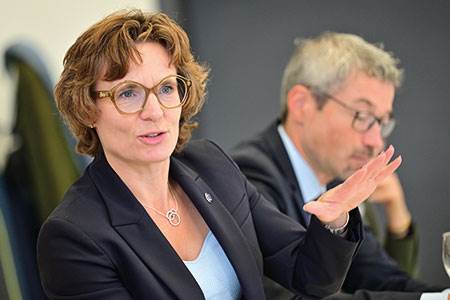
The world waited to see what difference the August joint statement would make. One month later, we thought we had the answer. The EU commissioner for the environment, Jessika Roswall, told journalists in Brussels that a new one-year delay for EUDR was in the works. EUDR had already suffered a 12-month postponement. The original date for it to start to apply was December 30, 2024 for larger companies and June 30, 2025 for smaller players. The Commission announced the first postponement on October 2 last year.
How the EU works
The justification Jessika Roswall gave for this proposed second press of the pause button was that concerns remained about the way the new information system for gathering EUDR-compliance data from companies might cope. She quickly made it clear that it would be necessary for the Commission to have discussions with the European Parliament and with representatives of the national governments of the 27 states before formally announcing a new delay. This is the way the EU works. These bodies are “the co-legislators” of the EU.
Plenty of commentators thought Ms Roswall may have been speaking prematurely. Others thought the information system explanation was implausible and that pressure from the US was the more likely reason for the new delay.
Leather’s main representative body in the EU, COTANCE, has shared a video of the remarks Ms Roswall made that day. She was on her way to a meeting about agriculture and fishing, but paused outside that gathering to talk to journalists. It was during those exchanges that she said she was going to ask the co-legislators for a further delay on the application of EUDR.
In her comments, Ms Roswall said: “Despite our efforts, we cannot get there [to the application of EUDR] without disruption to our businesses and supply chains. I hope the co-legislators will help us get the IT system we need.” As is clear from this, she insisted it was about the IT system, denying that her request was linked to the US-EU trade discussions. She said: “With a lot of information coming from businesses in a short space of time, there is a danger of overloading the system and a risk that it will not work.”
Good news fades fast
News of the proposed second delay came through during one of the leather industry’s most important gatherings of the year, Lineapelle and Simac-Tanning Tech in Milan. In fact, UNIC president, Fabrizio Nuti, wasted no time in spreading the news. At a formal opening event for the exhibitions, a senior Italian member of the European Parliament, Francesco Torselli, was a special guest. Addressing leather manufacturers and their partners, Mr Torselli said: “I want to offer you a message of hope. Even regulations that have seemed to be untouchable are being delayed and amended.”
As soon as Mr Torselli had finished his address, Fabrizio Nuti responded, saying: “Even as you were speaking, Francesco, I received a message to say the European Commission will propose a new delay on the implementation of EUDR.” Mr Nuti said he was pleased to be able to give people in the leather sector “some good news”. The glow faded quickly. All went quiet about the proposed delay until the October 21 announcement.
When the October proposal appeared, Mr Nuti called it “a profound disappointment”, adding that it was the latest in a long list of disappointments to emerge from Brussels.
In its reaction, COTANCE complained about the European Commission backing away from a commitment to carry out a scope-related impact assessment of EUDR. This was due in June 2025, COTANCE says, but will now be covered by a general review in June 2030. “This is unacceptable,” COTANCE contends, adding that the European Commission is ignoring evidence from an impact assessment that the leather industry commissioned itself. In the absence of a Brussels-led assessment, the leather industry commissioned the Sant’Anna School of Advanced Studies in Pisa to conduct a study in 2024. “There is no direct link between leather and deforestation,” COTANCE concludes, quoting the main finding of the study.
Small concessions
The October announcement makes it clear that there is no delay for larger companies, those with more than 50 employees and an annual turnover of more than €12 million. There is, however, an extra six months for small and micro operators. They will have until December 30, 2026 to prepare. According to the EU’s formal definition, a micro-enterprise is one that has fewer than 10 employees and an annual turnover of no more than €700,000. A small enterprise has fewer than 50 employees and an annual turnover of €12 million or less.
Another part of the proposal is that it should be easier and faster for micro and small operators to provide information about their compliance with EUDR. They will do this through a “one-time simplified declaration”. This will apply to suppliers of raw material as well as to downstream operators who use the raw material. They will still have plenty of work to do. They will have to supply information about their activities, including the geolocation or the postal address of all plots of land where “the relevant commodities” are produced. Once they have completed this, the micro and small operators will receive “a declaration identifier”, which they will be able to pass on with the materials or products they bring to market.
For companies that are too large to benefit from these concessions, EUDR will come into application on the scheduled date, December 30, 2025. These operators will have to establish and maintain a comprehensive due diligence system. They will have to collect information about the raw materials they source, including the identity of upstream suppliers and the geolocation of farms. They will use the information they collect to carry out a risk assessment to satisfy themselves that a product or commodity is deforestation-free. Then, before offering their own products, either on the EU market or for export, these companies will have to submit a due diligence statement (DDS) to the system the EU has built for EUDR.
However, the proposal says the authorities should only begin to carry out checks and other measures related to enforcement of the regulation from June 30, 2026, giving six months’ grace before scrutiny begins.
Leather-specific system
At Lineapelle, amid the mild euphoria of September’s short-lived respite, UNIC pressed ahead with its presentation of a new system to help companies in the leather value chain cope with the demands of EUDR. UNIC warmly welcomed the news of Jessika Roswall’s proposed second postponement. “To have extra time to get ready would be good,” UNIC told World Leather at Lineapelle, “but we are presenting the new tool because EUDR is still coming.” This proved prophetic.
The system, Hides Eco Track, is a cloud-based decision-support platform for EUDR compliance, specifically for the leather sector, including companies outside Italy. “All European producers of bovine leather will be able to use it,” says UNIC deputy director, Luca Boltri.
Rather than starting from scratch, UNIC worked with its counterpart for Italy’s wood and forestry sector, ConLegno. For obvious reasons, ConLegno has also had to work hard to prepare for the application of EUDR. It shared with UNIC its experience of developing a system to meet the deforestation regulation’s demands. ConLegno’s key person for due diligence, Chiara Cassandro, says there are plenty of parallels, although she also points out a key difference. “Cows move around; trees do not,” she says.
Another important partner in the development of Hides Eco Track was technology provider Terrasystem, a spin-off from the University of Tuscia in Viterbo. Terrasystem previously worked on traceability and compliance systems for sectors including hazelnuts. The hazelnut supply chain is crucial for high-profile consumer product companies, including Nestlé and Ferrero. They have come under scrutiny because of criticisms surrounding farm labour practices and other upstream issues. Aided by this work, Hides Eco Track has been in development since April 2025. Project manager, Claudio Belli, says testing began in October in preparation for going live in December.
“Other platforms are likely to come forward,” Luca Boltri says, “offering help with EUDR compliance for a variety of products, but this one is leather-specific. If, tomorrow, it turns out not to be necessary, I will be happy. But we have made the investment in this system so that, in the worst case, we will have something ready.” His point is that the industry still doesn’t know exactly what will happen with EUDR. The latest proposal still requires the approval of the co-legislators. It is fair to say that COTANCE and UNIC are far from the only organisations to have found the October document disappointing. What it means for EU-US trade discussions is another important point of discussion.
On October 28, COTANCE and 23 other bodies representing industries affected by EUDR issued an open statement urging the Commission to pause and reconsider before moving forward. They called for it to introduce a ‘stop-the-clock’ mechanism so that policymakers can make “a proper assessment” of EUDR’s impact before the regulation comes into application.
Mr Boltri insists that UNIC is still following developments “every day”. He adds that the organisation’s commitment to keeping its stakeholders as well informed as possible is undimmed. It is, however, no easy task, as the ups and downs of the autumn make clear.
The September attempt by European commissioner for the environment, Jessika Roswall, to postpone EUDR for a second time appears to have been in vain.
Credit: European Commission















