


The pull of protein
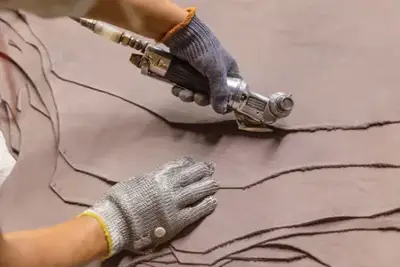
The new chair of CICB, Carlos Obregon, says “a repositioning” of leather is required. He argues that its circular credentials, including its links to the same raw material as many protein food supplements, can help convince young consumers that leather is a sustainable choice.
Earlier this year, Brazil’s national tanning industry association CICB elected Carlos Obregon as the new chair of its board of directors. In his day job, Mr Obregon is a director of JBS Couros.
An extensive range of leather industry professionals make up the CICB board, which works closely with the organisation’s executive team, led by executive president, José Fernando Bello.
In sharing his opinions about the current situation of the leather industry, in Brazil and globally, and his hopes for the future, Mr Obregon says he hopes the current trend for consuming protein in the form of gelatine and other food supplements will help the leather industry. “If young consumers are coming to appreciate protein,” he explains, “they should appreciate leather too because the raw material for both is the same. A hide is 100% protein.”
He says there is no doubt that some younger consumers may not view leather as an attractive option at the moment. They know little about the material or the industry behind it. What they have seen on social media platforms is unlikely to have painted leather in a kindly light. “But things are changing quickly,” he insists. “I hope more people will come to see that a sustainable product is one that comes from renewable resources, one that is circular and one that will last for a long time, not just for one fashion season.”
Back story
Mr Obregon is a native of the Brazilian leather industry’s stronghold state, Rio Grande do Sul, but lived in the interior, in the city of Santo Ângelo, around 350 kilometres west of Porto Alegre. He studied electrical engineering and, soon afterwards, moved to the state of São Paulo for post-graduate study in Campinas.
Moving to Campinas brought him into contact with Arnaldo Frizzo and, for the first time, through this important figure in the history of the industry in Brazil, with the leather sector. At the time of their meeting, Mr Frizzo was in a senior position at Curtume Cantúsio, a famous and influential Campinas leather manufacturing company. In the mid-1980s, Arnaldo Frizzo and a group of friends decided to set up on their own. They moved to Uberlândia in the state of Minas Gerais and founded Braspelco.
In time, Braspelco became the biggest manufacturer and exporter of leather in Brazil with 13 tanneries, two farms and its own footwear production company, which ran under the name Frizzo Calçados. It hired Carlos Obregon as its first employee and he remained at the group for more than 20 years. “We started from scratch, and I was there from day one,” he says. “As an engineer, I was able to contribute to the initial project, which was to build the tannery in Uberlândia.”
Industry commitment
When production began, he decided to commit to the industry and went on an intensive course to learn about leather manufacturing. But by 2006, an over-stretched Braspelco had changed its name to Xinguleather and was concentrating on contract tanning for another major group, Bertin. Two years later, it leased its Uberlândia tannery to Bertin, and when, in 2009, JBS took a majority stake in Bertin’s operations, it became part of JBS. Post-Braspelco, Carlos Obregon worked for a few years at Mato Boi, also in Minas Gerais, but he returned to Uberlândia in 2010 and became to be part of the senior management team at JBS. Since 2016, he has led the group’s Zenda Leather operation, which runs plants in Uruguay, Argentina, Mexico and Germany.
Returning to the subject of many consumers and brands holding leather in a less-than-high regard, it irks him that the notorious old photos of pit-tanning in Morocco still crop up in online reports, helping, in his words, to devalue leather further. “Hides ought to be transformed into leather,” he argues, “because leather is an extremely useful product. This is why manufacturers of synthetic alternatives try to copy leather, even when the composition of their materials is mostly oil.”
A good deal all round
He wants to reposition leather and says the whole value chain should work together to make that happen. He includes meat companies in this, saying that if leather is under-valued they lose out too. The repositioning he envisages would mean meat companies receiving a good price for the raw material and tanners receiving a good price for the leather.
“This is why we need good communication with the market and with consumers,” he insists. “There are certainly young consumers who seem to regard the use of leather as wrong. But what is really wrong is allowing hides to go to waste and choosing synthetic materials from non-renewable resources instead of leather.”
To make the hides into leather is to put them to the best possible use, Carlos Obregon argues, because hides are an inevitable “fruit of the food chain”. This is what makes hides and leather circular products. What the leather industry does is to reuse material that is not part of the “economic focus” of the livestock industry, he continues. “We have a way of absorbing something that would otherwise end up a burden to the meat industry,” he adds.
Work that will not go to waste
Sources at CICB confirm that the European Union Deforestation Regulation (EUDR) has been a major challenge for the leather industry in Brazil. If, definitively, leather is to remain outside the scope of the regulation, there are few countries that will celebrate this development more loudly. But Ricardo Andrade, a sustainability advisor at the industry body, said recently that, for the last three years, leather industry leaders in Brazil have been “going to sleep with thoughts of EUDR still on their minds”.
The work that the industry in Brazil has put into preparing for EUDR will not go to waste, according to Carlos Obregon. He says a programme to provide traceability across the whole of the leather value chain is ready. The federal Brazilian government is responsible for this wide-ranging project; 15 different industrial sectors have been involved.
“It will be good for Brazil,” he says. “We have to keep it going now. If you have traceability of the hide, you can have traceability for the whole supply chain. That means that if, say, there is an occurrence of an animal disease, you can act in a much more precise and targeted way to address it. If you can have the hide part in place, you can know exactly which farm has experienced an outbreak of a disease. This is an important advantage for our livestock industry. It will make our whole system more robust.”
Export activity
Specific to leather, he says he would like to see more robustness there too, with changes to the situation regarding exports (with currently between 70% and 80% of hides leaving the country as salted hides, wet blue, crust or finished leather, according to CICB). “We have a lot to offer,” Mr Obregon says, “and the more value we can add here in Brazil the better.”
He says the percentage share of salted hides is going up and that Brazil is now exporting around 500,000 hides at this stage of processing each month. Of the rest, wet blue takes up a large share, then crust and finished leather. He believes in the Brazilian Leather Project, a partnership between CICB and export promotions agency ApexBrasil, that aims to promote Brazilian leather in overseas markets. “It is helping us maintain and grow our share in important markets and also to generate business in new markets,” he says. “And if we can add more wet blue or crust instead of salted, so much the better. Perhaps more finished leather too. Anything we can do to add value is good. There are certainly markets in which we do not have a presence yet, but certainly could have.”
Internal market
Brazil, with its population of more than 210 million people, has an important domestic market too, of course. The CICB chairman would like to see internal growth for the country’s leather sector too, through the production and sale of more finished products made from leather. “This would help create employment and strengthen the value chain,” he explains. “Brazil has always been an important producer of leather footwear, for example, and it still is, but perhaps not as much as in the past. I have looked at statistics for the footwear industry and, if memory serves, the share that leather footwear had of total domestic footwear production in 2000 was around 50%. Last year, it was 12%.”
He makes the point that even if Brazilian manufacturers create leather footwear, furniture, accessories and other products from leather and those finished products go for export, it would be another important way of adding value.
A question of value
When he talks about repositioning leather, he insists that he is not talking necessarily about putting prices up. It is more a question of value than price. He wants consumers, including those with an insatiable appetite for protein, to realise and appreciate the value of leather.
“In this way, leather will come to have greater appeal in the market,” he concludes. “This may not be easy to achieve, but we can communicate better and speak up about the qualities of leather, about its naturalness and its circularity. We can also correct the untruths that consumers sometimes hear about leather. If consumers want to live more sustainably, they should use more leather. Leather stands out from all other materials.”
Added value. Brazil is exporting half a million salted hides a month. The new chairman of CICB would like companies to add as much value to the material as possible on home soil. Credit: JBS Couros


