


A monument in need of rebuilding
Our analysis of Kering’s confusing recent messages about leather concludes with this second article, this time focusing entirely on the group’s biggest brand, Gucci.
We reported in World Leather April-May 2026 that Kering has a new plan in place for the years ahead. Chief executive, Luca de Meo, has hinted heavily at important changes to the way the group sources and uses leather. At the same time, he has made it clear that leathergoods and footwear will continue to play an important role in attracting consumers to Kering brands, winning their loyalty and claiming a lasting share of their spending on luxury products.
In that first article, we reviewed the strategy that Mr de Meo, in post since September 2025, has laid out for the group’s principal brands, including Saint Laurent, Bottega Veneta and Balenciaga. We said we would devote this follow-up article to what he has in mind for the group’s biggest brand, Gucci.
Radical plan
Luca de Meo was previously chief executive of Renault. The context for introducing a radical plan so soon after his arrival at Kering is that the luxury group saw revenues decline by more than 25% between 2022 and 2025. Over the same period, Gucci’s revenues fell by more than 40%, reaching €6 billion in 2025. He says he remains confident in the group’s ability “to reinvent itself” and equally confident in the strength of its brands. Gucci is clearly the one that matters most, though. After only a few months in the job, the Milan-born group chief executive says he could see that Gucci had “lost some of its shine” and that “to reboot Gucci” needed to be a top priority.
He comments: “As an Italian national, it is easy for me to understand that Gucci is more than a brand. It is one of the most admired expressions of the culture of Italy. It is almost a monument.” Sticking to this theme, he talks about a Renaissance for the brand. Gucci is not, he continues, “vanilla ice-cream”. It is, instead, “spicy, sometimes bitter, sometimes super-sweet”. He insists that clients in the US have a clear grasp of what Gucci means. In contrast, he accepts that for consumers in important Asian markets, including China and South Korea, Gucci’s desirability has weakened “because our discipline faded”. Kering talks at length about desirability. In market research that measures the desirability of brands, Gucci is still in the global top five, Mr de Meo shares. A few years ago it held the number-one spot. He wants the brand to reclaim that position.
Slow to react
Gucci’s own chief executive, Francesca Bellettini, says that restoring desirability in China, “more than anywhere else”, is a matter of urgency for the brand. “We opened too many stores there,” she explains, “and we didn’t react immediately when we saw brand desirability going down”. Unproductive stores in China, as in other markets, will close. Gucci will figure out, including through its use of artificial intelligence, which products are particularly popular among Chinese consumers and make sure it gives those products precedence. “There is work to do but we are on the right track,” she insists.
An early example is the success of a black leather bag called the Borsetto that the brand launched in its spring-summer 2026 collection. Sales of this product in China are showing promising signs, Ms Bellettini says.
Achieving desirability means doing the right things, according to Luca de Meo. He continues: “We must recognise, with humility, that in recent years we have not always done the right things. The creative direction [of Gucci] lacked stability and clarity. The offer became too uneven and, sometimes, we diluted our identity by trying to be all things to all people. We were not always consistent in the quality of our products. We acknowledge these shortcomings and have already begun to correct them. We understand Gucci and we know what we have to do.”
Identity codes
This will involve what he calls refocusing the way the brand works; it will have “fewer, sharper, more coherent narratives”. What he wants is for it to be clear to people “within one second” that a product is from Gucci. How they will know will be through craftsmanship and “identity codes that are immediately Gucci, even when they are subtle”. Kering has come up with a name for this phenomenon of cultural expression: ‘La Gucci Vita’. It wants to bring back to life “the Gucci feeling” and project it to the world, to make it “unmissable again”.
Plenty of what happens at Gucci will still involve leather. Its most iconic bags will become increasingly important. These products represent around 10% of all Gucci leathergoods today; this should increase to 20% by 2030. “We will do this without losing our fashion authority,” Luca de Meo says.
The brand will concentrate on fewer families of products, more formality and higher quality, he continues. It will redesign its entry-level offering, develop “a strong mid-price proposal” with bags priced at between €2,000 and €3,000 each, and “elevate the top tier” by using “richer materials and distinctive details”. The Gucci Renaissance will involve a renewal of “price architecture” to make sure “perceived value” and price remain aligned. The group chief executive describes this as an essential element of rebuilding trust and the desirability he craves. Across the ranges, Gucci will rationalise its leathergoods assortment by around 20% by 2030. In spite of this, his ambition is for the brand to deliver an extra €1 billion in leathergoods revenues by the same year.
Material doubt
As we said in World Leather April-May, it looks on the surface as though the pledges to preserve quality, craftsmanship, identity and perceived value should send positive signals to the companies that operate in Gucci’s leather value chain. But Mr de Meo’s message relating to leather is double-edged.
Kering is intent on lowering the number of suppliers it works with to reduce complexity and cost, although multi-year partnerships will be on offer for companies on which the group bestows preferred-supplier status. Yes, tanners and finished leather product and footwear manufacturers will be among them, but the chief executive has also made it clear that he wants to diversify the group’s material sourcing. He has given no details so far of which materials he wants Gucci and the group’s other brands to source in larger volumes, but he has said he wants their dependency on leather to reduce. He cites “evolving client expectations, client pressure and animal welfare considerations” as his reasons for calling on the group “to broaden our material universe”.
Cause for complaint
His attempt to explain this deserves some of the criticism he himself has levelled at the recent past leadership of Gucci. What he says lacks clarity and is far from a coherent narrative. It also smarts of another of his complaints, that companies ought not to try to be all things to all people. He goes on to talk of a wish to “decouple growth from leather dependency” and for brands to achieve a reduction in “leather intensity”. Kering will measure this as the number of square-metres of leather the group purchases for each €1 million in revenues it brings in from leathergoods and shoes. Mr de Meo wants this “leather intensity” to reduce by 30% by 2028, with 2025 as the base year.
Based on figures Kering has published for revenue by product category, we can put a figure of around €3 billion for the revenues Gucci achieved in 2025 from sales of leathergoods. We do not know how many square-metres of leather Gucci consumed to achieve those sales, but we can call it x. The point is that if those revenues remain constant, Luca de Meo will expect Gucci to be using x minus 30% by 2028. But he wants Gucci’s designers, craftspeople, sourcing professionals and strategic suppliers to help it take leathergoods revenues to €4 billion by 2030. He appears to be giving them the task of achieving this extra €1 billion in leathergoods revenue while using less leather. And, somehow, the team is to preserve ‘La Gucci Vita’ and bring about a Renaissance of the brand along the way.
Mr de Meo outlined these plans at a Kering Capital Markets Day in Florence in April. To speak of Renaissance, of monuments and of cultural icons in Florence is to bring to mind masterpieces such as Michelangelo’s David, located just 2 kilometres from where the Kering event took place. When Michelangelo completed the statue in 1504, a series of new commissions quickly came his way, including one for enormous sculptures of the twelve apostles for Florence cathedral, and another for, according to the original plan, 40 statues for the tomb of Pope Julius II. Demand for Michelangelo’s craftsmanship soared (so much so he couldn’t keep up). Influential patrons desired the fruit of his genius and hard work; they were willing to pay for it. There is no record anywhere of anyone asking him to carry out these commissions while sourcing less marble from the quarries of Carrara.
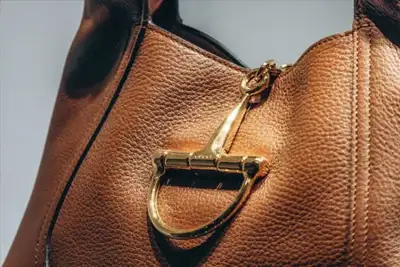
Leathergoods will be a key contributor to Gucci’s Renaissance. Credit: Shutterstock


