Act of faith
Later this year, the European Commission will publish a new Circular Economy Act. Meanwhile, China’s most recent Five-Year Plan suggests that a shift to circular models of production and consumption could happen there more quickly.
The European Union (EU) is tireless in presenting itself as a world leader in developing policies to support a transition to a circular economy. Commissioner for the environment, Jessika Roswall, is still intent on presenting a formal Circular Economy Act before the end of this year. The new act, the Commission says, will enhance the EU’s competitiveness while promoting circular economy business models, sustainable production and decarbonisation. This act will build on the EU’s second circular economy action plan.
It is now six years since the action plan became public. We at World Leather are grateful because it led us, in 2020, to start this series of long-read articles that claim and justify leather’s place in any discussion about the circular economy. But six years is a long time.
Years in the making
There has been no shortage of talk about the changes that a circular transition requires of governments, companies and consumers. Brussels-based public affairs consultancy Publyon has said that one of the aims of the new act will be to double the use of “circular materials” in goods production in Europe by 2030. This sounds promising, but doubling the figure, if it happens, will take circular materials’ share to 24%. This means that, six years on from the publication of the second circular economy action plan, only 12% of the materials companies are using in their manufacturing in the EU are circular.
At the time of writing, the most recent public comments Jessika Roswall has made about what we can expect from the Circular Economy Act were in a speech in Luxembourg in March. She said: “In his new book ‘The Growth Story of the 21st Century’, [economist] Nicholas Stern says that there is no horse-race between climate action and economic development. They go hand-in-hand. I couldn’t agree more. We see this potential in the circular economy.”
She went on to say that every tonne of raw material we save and all products or materials we reuse or recycle, will strengthen Europe’s economic resilience, boost competitiveness and reduce environmental consequences. She also talked about enhancing “resource efficiency” and reducing EU economies’ dependence on imported raw materials. Dare we hope for support and recognition for the EU’s beleaguered tanners? They are, after all, making available to finished product manufacturers one of the most circular raw materials imaginable.
Investment gap
Ms Roswall highlights the need for investment. She quotes a figure that the European Commission recently announced in a joint statement with the European Investment Bank. They looked at the amounts of money currently going into circular projects in Europe and the amount they think will be required for the EU to meet its targets on circularity. This comparison has resulted in what the Commissioner for the environment calls a circular-economy investment gap of more than €80 billion per year.
Within this, she earmarks €5 billion per year as the investment gap for textiles, clothing, leather and footwear (TCLF). She views “private investment” as the most likely source of any extra funding, but seems to accept the need for the European Commission to “deploy all tools” to help secure this private investment. She comes across as confident that the investment will be forthcoming and she insists that the new act will accelerate the transformation to circularity.
Publyon’s view is that the Circular Economy Act will bring a new level of emphasis on waste prevention, reuse, repair and product longevity. The public affairs consultancy adds that there could also be greater clarity on public procurement criteria and targets for recycled content. These aspects, too, would give encouragement to leather manufacturers. We will know soon enough. It may take longer for us to know if the policies the act outlines are able to drive meaningful change for manufacturing companies.
Five-Year Plan
Something else happened in March that is likely to have an effect on the move to a circular economy. Almost at the same time as Jessika Roswall’s speech in Luxembourg, the National People’s Congress, China’s top-tier policy-making body, met in Beijing and gave official approval to the country’s newest Five-Year Plan. This, the fifteenth Five-Year Plan that China’s central government has drawn up since the 1950s, emerged in October 2025. It is a guide to the policies that will come into force in the period between now and 2030.
The new guidelines are explicit when it comes to the circular economy. “We should promote green and low-carbon transitions in industry, urban and rural development, transportation, energy, and other key sectors,” the plan says. “The systems for resource consumption control and resource conservation should be improved. Refuse sorting and recycling should be stepped up to boost the circular economy. Incentives for eco-friendly consumption should be boosted, and green and low-carbon lifestyles should be promoted.”
Eligible for upgrade
In the plan, China’s central government says it wants to establish systems for assessing and managing the carbon footprint of companies, projects and individual products. New technologies and new regulation methods will be part of this landscape.
China has made it clear that it wants not just to keep its manufacturing base but to upgrade it. “We should promote technological transformation and upgrading to shift toward digital and intelligent development in the manufacturing sector and develop smart, green, and service-oriented manufacturing,” the plan says. Among the “key industries” that the Five-Year Plan mentions as being in line for upgrading is the sector it refers to as light industry. China’s globally important leather industry fits into this sector. In fact, the president of the China Leather Industry Association, Yu Lizhong, is also the vice-chairman of the China National Light Industry Council.
Track improvements
The history of China’s progress in the 2020s so far suggests that it could well make faster circular-economy advances than the EU. The International Union of Railways (UIC) identifies high-speed rail services as those on which trains will reach speeds of 200 kilometres per hour (although many services are faster). China’s system stipulates 250 kilometres per hour for services to have a high-speed classification.
Before 2008, China had no high-speed rail services, but built one that year to coincide with the Beijing Olympics. It has not looked back. By 2020, according to the national railway operator, China’s high-speed rail network covered 37,900 kilometres. By the end of 2025, the network covered 50,400 kilometres, an increase of 33% in the first half of this decade. This progress will continue. Ongoing improvement of transportation systems is part of the new Five-Year Plan.
The EU’s high-speed rail network in 2020 ran for 11,500 kilometres. Late last year, the European Commission gave 12,128 kilometres as a more up-to-date figure, an increase of 5.4%.
At the wheel
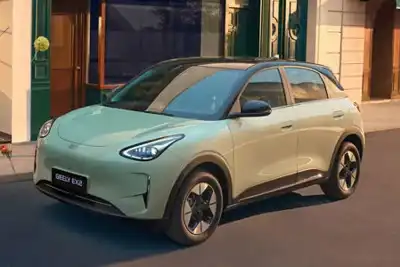
Electric cars give us another example. In 2020, the EU was ahead of China in the sales of battery electric vehicles (BEVs). That year, BEVs had a 5.3% share of the EU market and a 4.7% share of the market in China. These figures come from a report published in late March this year by the European Federation for Transport and Environ-ment, a Brussels-based advocacy group that campaigns for clean transport and energy. It quotes a number of sources for its statistics, including the European Automobile Manufacturers’ Association, Bloomberg Intelligence and the International Energy Agency.
The report, which has the title ‘The State of European Transport 2026’, goes on to give year-by-year statistics for this decade, closing with figures for 2025. Last year, according to Transport and Environment, BEVs had a 17.4% share of the EU market and a 31.2% share of the Chinese market. In a recent book, a prominent economist said: “In the EU, automotive companies have consistently dominated research and innovation spending. Now the European car industry has serious problems, in large measure because the future is in electric vehicles and Chinese firms have a substantial lead.” Like the quote Jessika Roswall picked out, this is from ‘The Growth Story of the 21st Century’ by Nicholas Stern.
He goes on to say: “China recognises its major role in world emissions, its own vulnerability to climate change and the vulnerability of poorer countries. It recognises, and is taking, the great national and global economic opportunities in the green transition.”
The Geely EX2, a pure electric hatchback, is currently China’s top-selling car. Credit: Geely Auto